
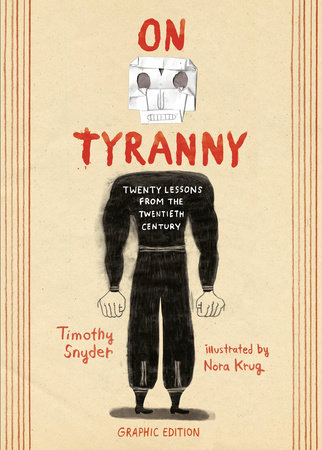
On Tyranny: Twenty Lessons from the Twentieth Century by Timothy Snyder (illustrated by Nora Krug; published by Ten Speed Press in 2021)
I was interested in reading the graphic novel adaptation of On Tyranny because I enjoyed reading Timothy Snyder’s original book, and because I was already familiar with Nora Krug’s work as a graphic novelist. (Several years ago, I read Krug’s book Belonging: A German Reckons with History and Home about researching the German side of her family’s history. I also briefly met Krug at New York Comic Con in 2023, where I picked up her book Diaries of War: Two Visual Accounts from Ukraine and Russia, which was based on her correspondence with friends living in both Russia and Ukraine when the Russian invasion began).
Contrary to what one might expect, On Tyranny is not a book despairing about the state of the world—instead, Snyder presents 20 key lessons derived from tyranny in the 20th century, dives into the history informing each lesson, and identifies actions we can all take at the individual level to fight against tyranny in our own small corners of the world. Here are the 20 lessons, accompanied by a few quotes that stuck out to me:
- Do not obey in advance.
- Defend institutions. (Snyder writes, “The mistake is to assume that rulers who came to power through institutions cannot change or destroy those very institutions—even when that is exactly what they have announced they will do.”)
- Beware the one-party state. (Snyder: “A party emboldened by a favorable election result, or denying an unfavorable one, might change the system from within [… through] some combination of spectacle, repression, and salami tactics, slicing off layers of opposition one by one.”)
- Take responsibility for the face of the world. (Snyder: “The symbols of today enable the reality of tomorrow.” He argues that putting up symbols that indicate compliance to ensure you’re left alone actually extend a regime’s power, because other people will interpret your compliance as loyalty, even if you’re resisting in secret.)
- Remember professional ethics.
- Be wary of paramilitaries.
- Be reflective if you must be armed. (Snyder writes, “Without conformists, the great atrocities [of the 20th Century would have been impossible.”)
- Stand out. (Snyder: “The moment you set an example, the spell of the status quo is broken, and others will follow.”)
- Be kind to our language. (Snyder: “Make an effort to separate yourself from the Internet. Read books.”)
- Believe in the truth. (Snyder: “A billionaire is someone who can pay neither his taxes nor his debts. […] Once truth had become oracular rather than factual, evidence was irrelevant. […] Post-truth is pre-fascism.”)
- Investigate. (Snyder: “Subsidize investigative journalism. […] The individual who investigates is also the citizen who builds. The leader who dislikes investigators is a potential tyrant. […] It is derision that is mainstream and easy, and actual journalism that is edge and difficult.”)
- Make eye contact and small talk.
- Practice corporeal politics.
- Establish a private life. (Snyder writes, “Try not to have hooks for tyrants to hang you on.”)
- Contribute to good causes. (Snyder: “Sharing an undertaking teaches us that we can trust people beyond a narrow circle of friends and families, and helps us recognize authority from whom we can learn.”)
- Learn from peers in other countries. (Snyder: “[…] having a passport is not a sign of surrender. On the contrary, it is liberating, since it creates the possibility of new experiences. It allows us to see how other people, sometimes wiser than we, react to similar problems.”)
- Listen for dangerous words.
- Be calm when the unthinkable happens. (Snyder writes, “Our natural fear and grief must not enable the destruction of our institutions. Courage does not mean not fearing, or not grieving. It does mean recognizing and resisting terror management right away, from the moment of attack, precisely when it seems most difficult to do so.”)
- Be a patriot. (Snyder: “A patriot […] wants the nation to live up to its ideals, which means asking us to be our best selves. A patriot must be concerned with the real world, which is the only place where their country can be loved and sustained. A patriot has universal values, standards by which they judge their nation, always wishing it well—and wishing that it would do better.”)
- Be as courageous as you can. (Snyder: “If none of us is prepared to die for freedom, then all of us will die under tyranny. […] History gives us the company of those who have done and suffered more than we have.”)
Having now read both the graphic novel adaptation and the original book, I highly recommend reading the graphic novel version. Krug’s illustrations add additional dimension to Snyder’s words, drawing the reader in. She incorporates drawings, historical photographs, and different artistic techniques to keep her presentation of Snyder’s words dynamic—all of these elements add more layers of meaning and history to an already compelling read. As an added bonus, Snyder updated On Tyranny, so there is additional useful text in this graphic novel that wasn’t in the version of his book that I read back in 2017.
I also appreciated that Krug varied her art and page layouts, so the book never felt visually repetitive to me. There were a few spots where I felt the layout could have more clearly indicated the flow of the text for the reader, but there were many more places where I appreciated how Krug directed the reader’s gaze to follow the narrative across the page.
I believe On Tyranny should be required reading for everyone—older children, teens, and adults alike—because it encourages us all to be good people who take care of each other even in the face of adversity. Snyder’s words provide not just history lessons, but also a call to action for all of us: be kind, do good in your little corner of the world, and fight back against injustice.

 MOLO WRITES
One thought on “Review: On Tyranny”